

Google Chrome adds V8 Sandbox for improved security
Google has reported help for what’s known as a V8 Sandbox in the Chrome internet browser with an end goal to address memory debasement issues.
The sandbox, as per V8 Security specialized lead Samuel Groß, expects to forestall “memory debasement in V8 from spreading inside the host cycle.”
The pursuit behemoth has depicted V8 Sandbox as a lightweight, in-process sandbox for the JavaScript and WebAssembly motor that is intended to moderate normal V8 weaknesses.
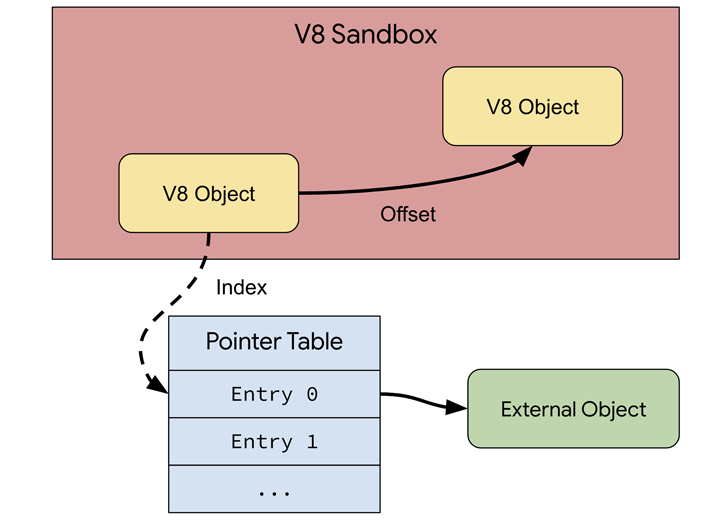
The thought is to restrict the effect of V8 weaknesses by limiting the code executed by V8 to a subset of the interaction’s virtual location space (“the sandbox”) and segregating it from the remainder of the cycle.
Deficiencies influencing V8 have represented a huge piece of the zero-day weaknesses that Google has tended to somewhere in the range of 2021 and 2023, with upwards of 16 security imperfections found throughout the time span.
“The sandbox accepts that an aggressor can randomly and simultaneously adjust any memory inside the sandbox address space as this crude can be developed from normal V8 weaknesses,” the Chromium group said.
“Further, it is accepted that an assailant will actually want to peruse memory beyond the sandbox, for instance, through equipment side channels. The sandbox then, at that point, means to shield the remainder of the interaction from such an aggressor. In that capacity, any debasement of memory beyond the sandbox address space is viewed as a sandbox infringement.”
Groß underlined the difficulties with handling V8 weaknesses by changing to a memory-safe language like Rust or equipment memory wellbeing draws near, for example, memory labeling, given the “inconspicuous rationale issues” that can be taken advantage of to ruin memory, dissimilar to exemplary memory security bugs like use-after-liberates, too far out gets to, and others.
“Virtually all weaknesses found and took advantage of in V8 today share one thing practically speaking: the possible memory defilement fundamentally occurs inside the V8 load on the grounds that the compiler and runtime (nearly) solely work on V8 HeapObject examples,” Groß said.
Considering that these issues can’t be safeguarded by similar strategies utilized for average memory-defilement weaknesses, the V8 Sandbox is intended to disengage V8’s store memory to such an extent that should any memory debasement happen, it can’t get away from the security limits to different pieces of the cycle’s memory.
This is achieved by supplanting all information types that can access out-of-sandbox memory with “sandbox-viable” options, accordingly successfully keeping an aggressor from getting to other memory. The sandbox can empowered by set “v8_enable_sandbox” to valid in the gn args.
Benchmark results from Speedometer and JetStream show that the security include adds an above of around 1% on average jobs, permitting it to be empowered as a matter of course beginning with Chrome rendition 123, crossing Android, ChromeOS, Linux, macOS, and Windows.
“The V8 Sandbox requires a 64-digit framework as need might arise to save a lot of virtual location space, at present one terabyte,” Groß said.
“The sandbox is propelled by the way that ongoing memory security advancements are to a great extent irrelevant to improving JavaScript motors. While these advances neglect to forestall memory debasement in V8 itself, they can as a matter of fact safeguard the V8 Sandbox assault surface. The sandbox is in this way an essential step towards memory security.”
The improvement comes as Google featured the job by Piece Address Sanitizer (KASan) in identifying memory bugs in local code and assist with solidifying Android firmware security, adding it utilized the compiler-based device for finding in excess of 40 bugs.
“Utilizing KASan empowered forms during testing and additionally fluffing can assist with getting memory debasement weaknesses and strength issues before they land on client gadgets,” Eugene Rodionov and Ivan Lozano from the Android group said.